

Diagnostic assessment
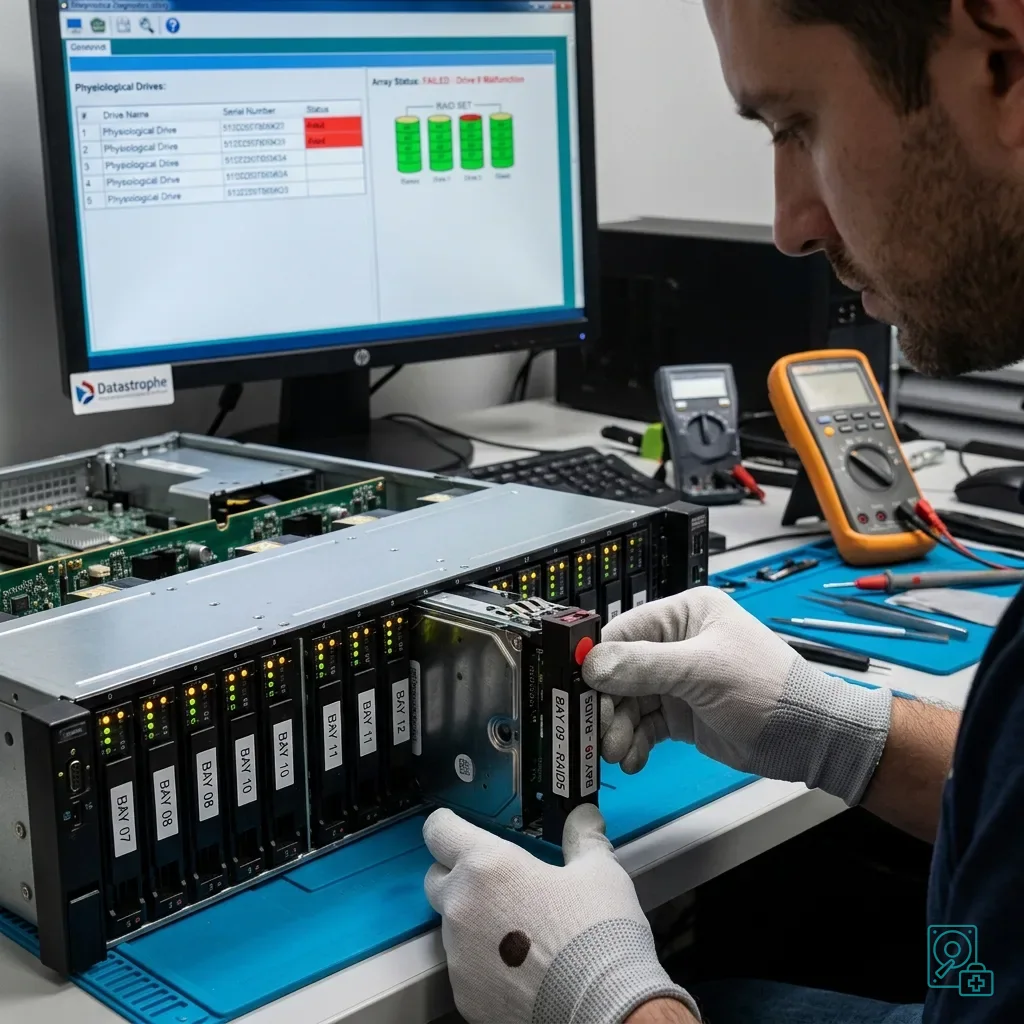
Workload Can Turn A Simple Failure Into A Critical Incident
A server RAID can appear stable under ordinary workload. Once a member fails, survivors read more, the controller writes continuously, applications keep using the volume, and backups add pressure.
This combination explains load-related failure. Rebuilding often exposes weak sectors, heat, marginal power, intermittent backplanes, controller errors, or nearly full capacity beyond the replacement disk itself.
Early signs can be deceptive. The server still runs, but response times rise, I/O errors enter the logs, rebuild progress stalls or another member leaves the group; each should be treated as a serious warning rather than ordinary slowdown.
The RAID data recovery service describes the service process. This article focuses on the vulnerable period in which reconstruction and active server workload compete for the same storage.
Preserve the state before adding another operation. A forced rebuild, restore to the same location or undocumented restart can change member metadata and make the later recovery path less certain.
Business timing matters too. Reconstruction during financial close, mass synchronisation or a backup window encounters a very different I/O profile from a quiet period, so scheduling can influence risk as much as the command itself.
Diagnostic assessment
Rebuilds Increase Reads And Writes
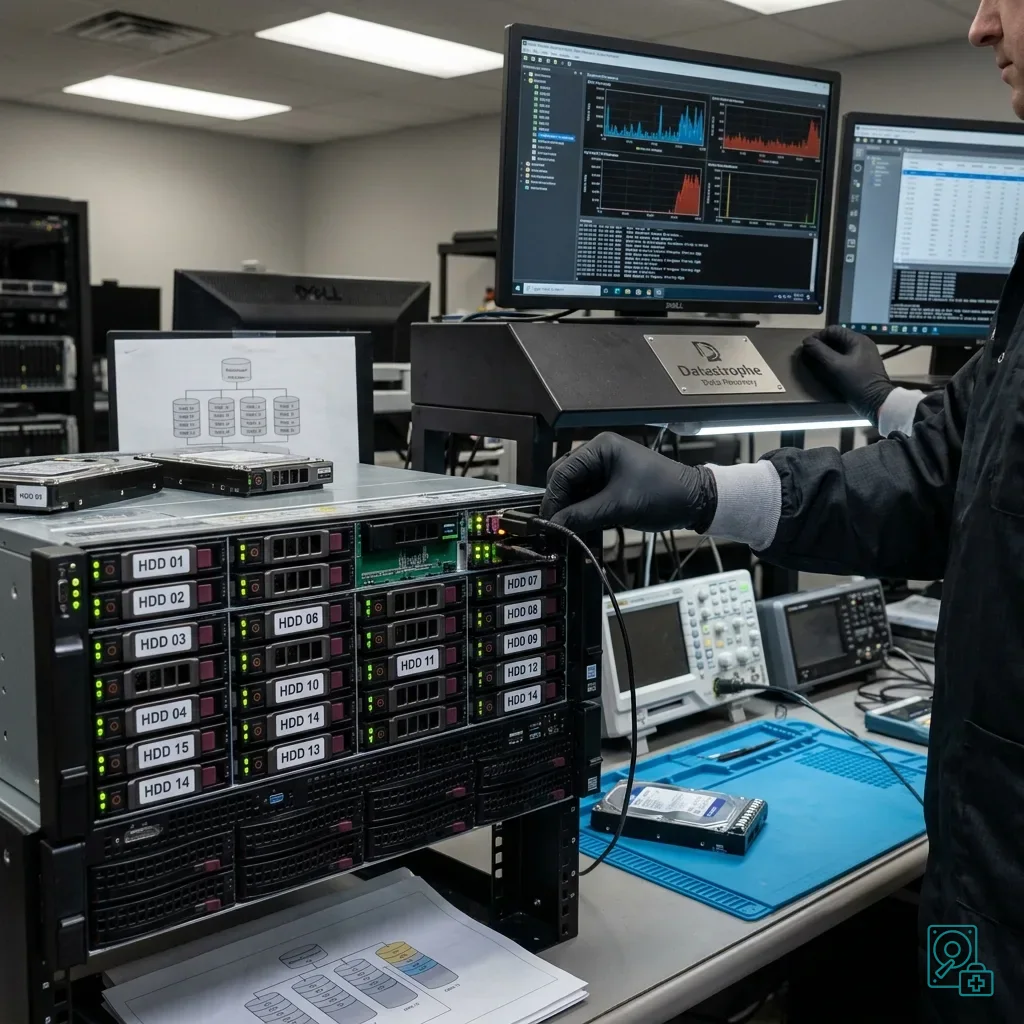
RAID reconstruction is not neutral background work. It reads survivors, calculates blocks, and writes the target while applications, backups, scans, and VMs compete for the same controller and media.
If another member has weak sectors, sustained reading can push it beyond recovery. The server may move from degraded availability to an incoherent volume, especially where disks share age and conditions.
Assess member health before allowing progress to continue unchecked. SMART, RAID-controller, operating-system and hypervisor logs can indicate whether risk is confined to one disk or extends across the enclosure.
The guide to repeated server-disk failure assessment adds context. Closely spaced faults and difficult rebuilds should be treated as a system problem, not merely a queue of members to replace.
In some cases the safer order is to reduce load, freeze the configuration and acquire the sources first. RAID level, number of unstable disks, data importance and operational urgency should determine that decision.
Diagnostic assessment
Include The Controller, Backplane And Power Supply
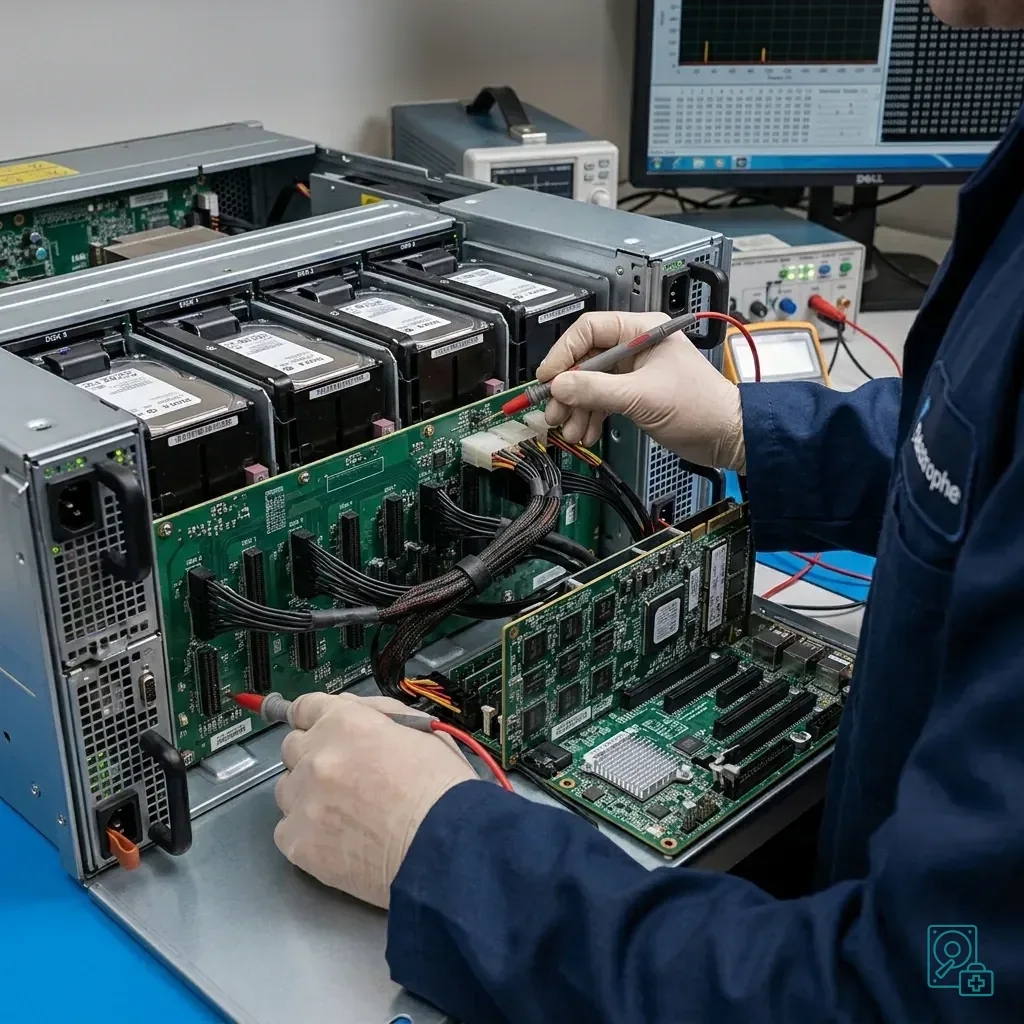
A server RAID relies on shared controller, backplane, cables, power, and cooling. Replacing one member cannot resolve a fault rooted in common infrastructure.
Backplanes are often overlooked. An intermittent bay can mimic media failure and becomes especially dangerous when rebuilding repeatedly traverses every member.
Heat and power deserve the same attention. A dense rack, restricted airflow or heavily loaded supply may multiply faults during peak activity, causing failure at the exact time the RAID demands its greatest sustained performance.
The article on RAID redundancy and its limits reinforces an essential point: redundancy is not backup and cannot protect against a common cause, human error or an incorrectly started rebuild.
Assessment must therefore include both hardware and logical layers. RAID level, member order, metadata, logs and replacement history are all needed to determine what source state can still be preserved.
Diagnostic assessment
Set Priorities Before Bringing The Volume Back
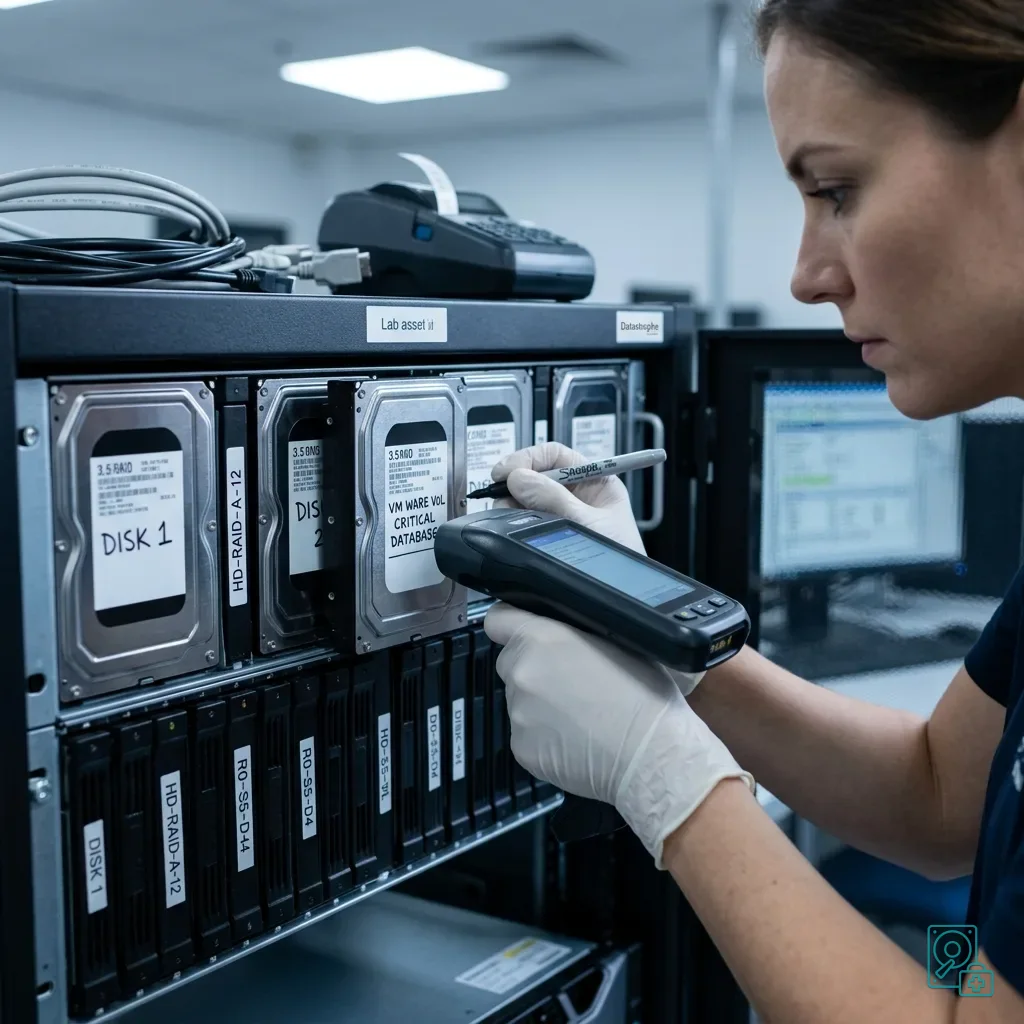
Rank server information explicitly. Business databases, VMs, client folders, email, production applications, and archives have different urgency that array repair should not obscure.
Service may resume from a separate verified copy while original members remain available. Restoring to the wrong destination or resetting the group can erase needed evidence.
Record every prior attempt: replaced disk and bay, rebuild start, percentage reached, displayed messages, restarts and backup jobs triggered. This chronology prevents the same risky operation being repeated under a different name.
The article on why critical server data is lost examines business priorities. On a busy RAID, that ranking helps choose among rapid failover, technical acquisition and controlled reconstruction.
A volume returning online should not immediately be called healthy. Check priority files, databases and virtual machines before concluding that the incident and its logical consequences have ended.
Diagnostic assessment
Prepare A Controlled Intervention
Useful preparation is concrete: server and controller models, RAID level, member count, exact order, replaced disks, alerts, logs and priority files. Complete facts reduce the need to infer configuration while sources remain fragile.
Do not mix members or test them individually without a traceable record. Reversal, initialisation or forced import can modify metadata required to assemble the logical volume later.
If partial server availability is mandatory, make that constraint explicit. Some cases permit separate continuity arrangements while protecting the source set; in others, a controlled shutdown presents the lowest data risk.
Datastrophe can assess a loaded server RAID with data value taking precedence over immediate hardware restart. The aim is to separate member failure, shared cause, logical corruption and the realistic limits of recovery.
Keep prevention straightforward after the incident: tested backups, acted-upon alerts, documented RAID configuration, adequate cooling and a known rebuild procedure. Together they prevent one component fault from becoming a full service crisis.
Where the RAID hosts virtual machines, include VM files, snapshots and datastores in acceptance checks. Controller completion does not prove a guest is coherent when application writes were interrupted during reconstruction.
Diagnostic assessment
Primary Technical References And Limits
Reference scope — RAID production rebuild risk: For server RAID production rebuild risk, the primary references used are Linux MD administration guide. Physical evidence — RAID production rebuild risk: They define the relevant preservation, storage or validation concepts, but they cannot establish the exact physical condition, controller state, key availability or business consistency of the device received. Controller evidence — RAID production rebuild risk: Those points require measurements on the original set and verification on copies.
Diagnostic assessment
Arrange A Controlled Assessment
Complete set — RAID production rebuild risk: For a technical assessment of server RAID production rebuild risk, provide the complete device or storage set, its associated power and interface parts, the symptom timeline and the priority data. Incident history — RAID production rebuild risk: Keep member order, labels and authorised credentials separate from the parcel paperwork; do not restart the source merely to obtain a new screenshot.
Laboratory responsibility — RAID production rebuild risk: Datastrophe performs the diagnosis, integrity checks and recovery directly in its own laboratory with its own team. Free assessment — RAID production rebuild risk: Diagnosis and the quote are free. Transport boundary — RAID production rebuild risk: Return courier service is included; the carrier moves only the sealed parcel and neither accesses nor processes its data.
Controlled list — RAID production rebuild risk: Before any payment, the client receives the proposed price and a checked list. Verification classes — RAID production rebuild risk: Each item is classified, in order, as recoverable_verified, partial, detected_unverified or unrecoverable. Payment trigger — RAID production rebuild risk: Only recoverable_verified items whose contents were checked and found usable are presented as recoverable. No-result rule — RAID production rebuild risk: Payment is due only after the client accepts both the list and the price.
No-result rule — RAID production rebuild risk: If no usable data is verified, recovery fails, or the client declines the list or price, no standard fee is payable. Rare-part exception — RAID production rebuild risk: The only exception is a rare, costly and non-refundable part, which may be ordered only after a separate, explicit and priced proposal has been accepted.