
Diagnostic assessment
Fault Type Drives The Initial Scope
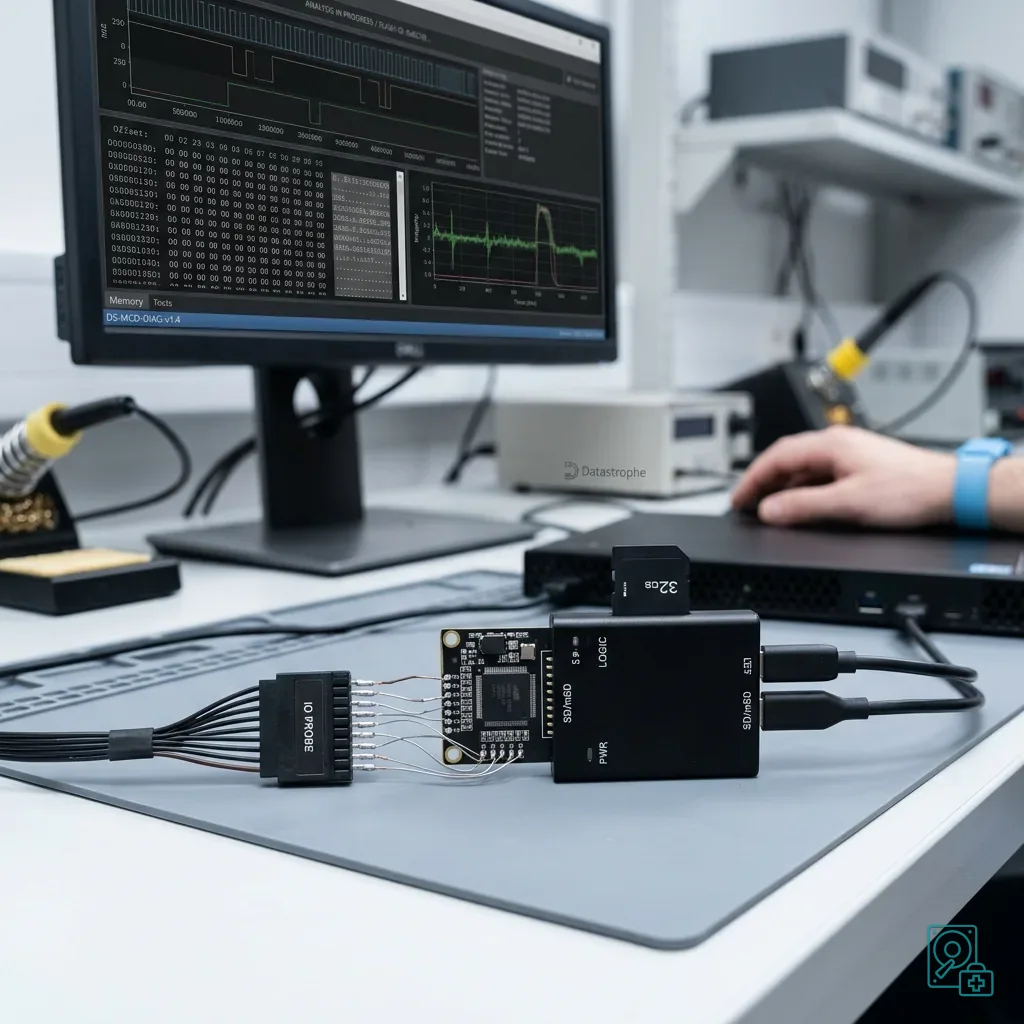
Memory-card recovery cost cannot be reduced to card size. A small microSD card may require more work than a larger card when it is physically damaged, its controller responds poorly or its files are highly fragmented.
Logical and physical failures need different methods. Deletion, formatting and file-system corruption are not handled like a cracked, corroded, unrecognized or unstable card. Assessment establishes that level of intervention.
A card visible in a camera or computer is not necessarily straightforward. It may request formatting, show the wrong capacity, contain empty files or disconnect during a copy. Those symptoms affect both analysis time and the caution required.
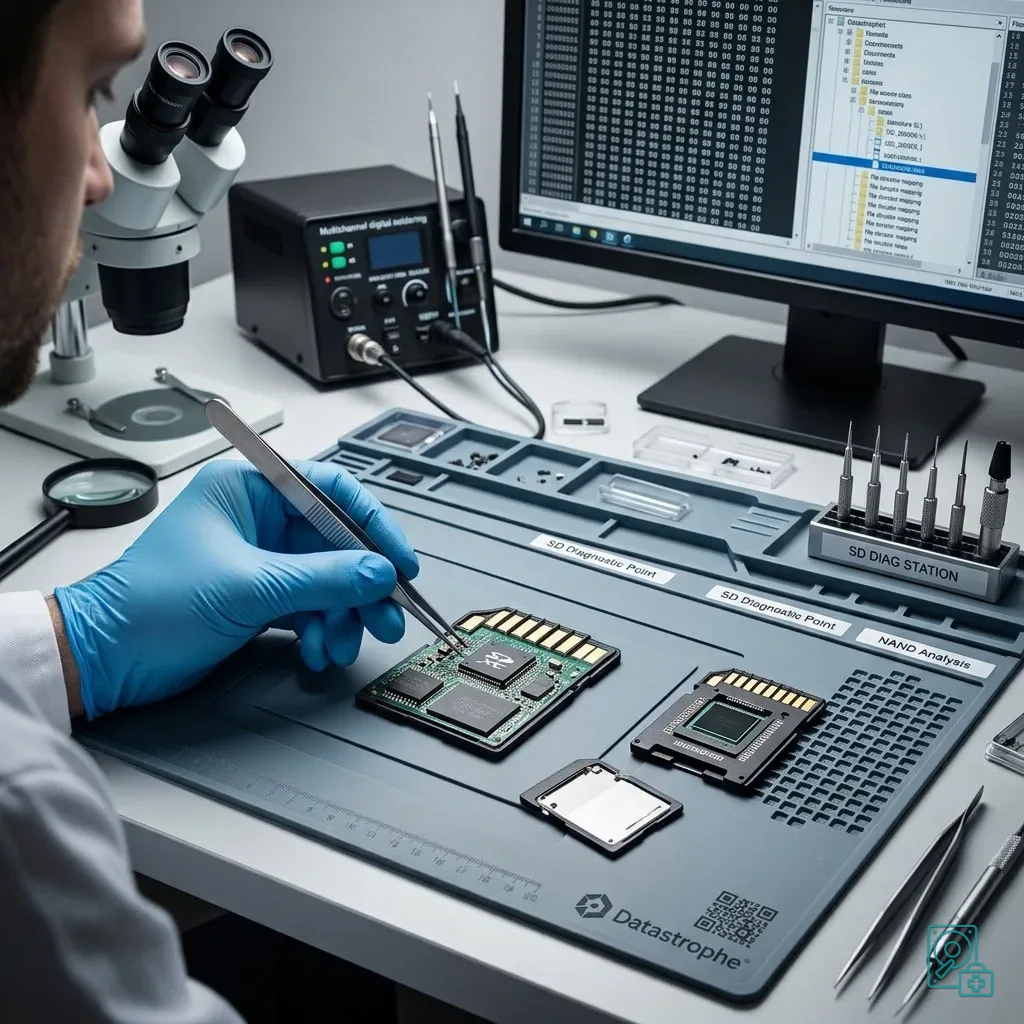
For a damaged card, the memory card data recovery path begins with evidence rather than a menu price. Capacity, stability, physical condition and the required files determine the work, so a fixed figure before diagnosis would be misleading.
Use context matters as well. A stills camera, onboard camera, drone, audio recorder or industrial system can create different formats and folder structures.
Two cards with the same capacity can therefore require very different work. A readable card left untouched after the incident is usually easier to scope than one that was bent, wet or reused.
Diagnostic assessment
Capacity Does Not Define Data Value
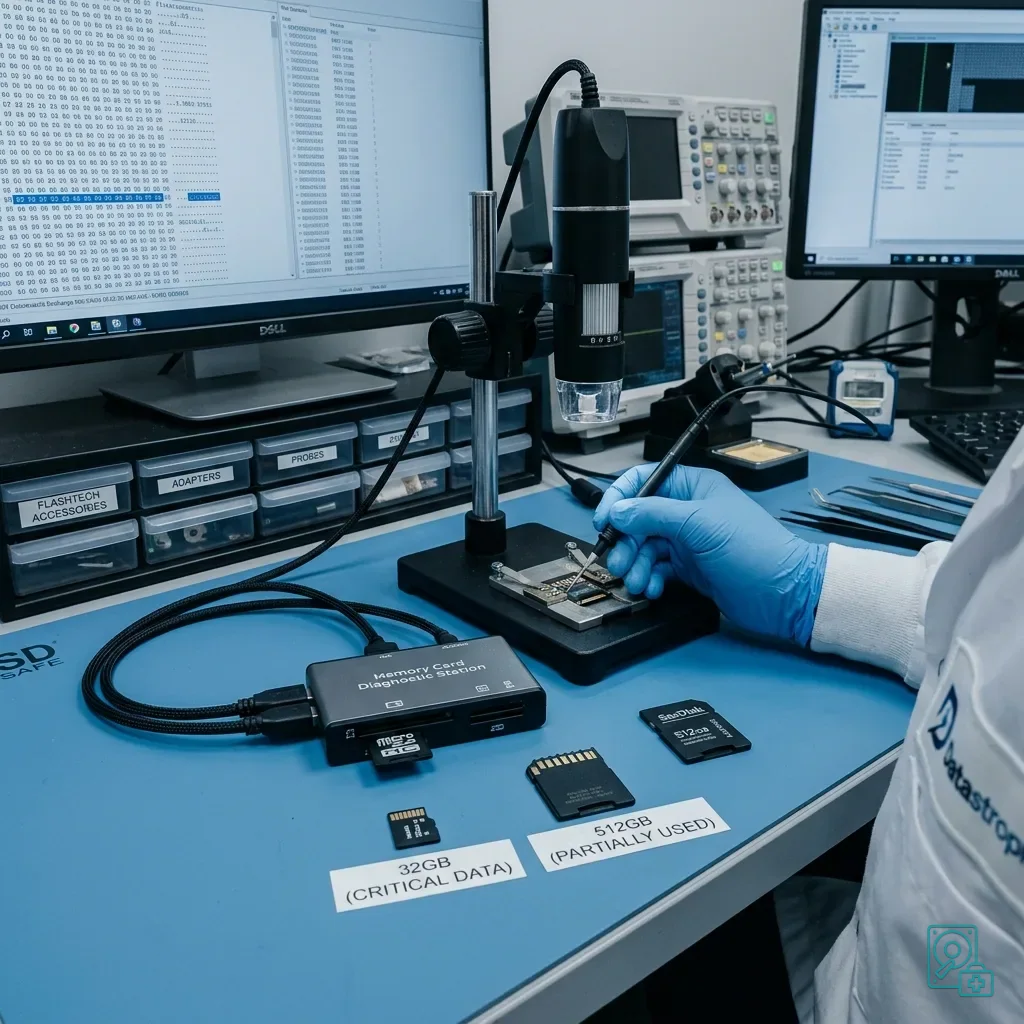
A 32 GB card can contain irreplaceable photographs, important video or production files, while a 512 GB card may be mostly empty. The value of the case does not rise mechanically with capacity.
Capacity mainly affects reading, imaging and checking time. The most difficult operations may instead come from unstable NAND, damaged tables, proprietary formats or heavy fragmentation.
Priorities help define the work. If the client needs one photo session, video period, audio folder or evidential file, checking can focus on it. Without priorities, the result may be large but difficult to interpret.
Damaged memory-card recovery describes common faults. Cost depends on how those faults obstruct access to the useful files.
Handover work also matters. Thousands of fragments, duplicates and partial versions need different checking from one coherent folder; time is spent not only reading but organizing the outcome.
That organization prevents an unusable result. Files without reliable dates or structure, and large numbers of duplicates, may need further sorting before the client can see what is genuinely useful.

Diagnostic assessment
Earlier Attempts Can Increase Complexity
Actions taken before assessment can affect cost and outcome. A tool run for hours, file-system repair, formatting, reuse or an interrupted copy may all change the data state.
Writes are particularly important on memory cards. A new photograph, later video or initialization can overwrite useful areas even when the card appears to work afterwards.
Poor adapters and readers can also create errors. A card that disconnects during a scan may be stressed without producing a useful copy, so stop once the files have clear value.
Mistakes after data loss covers the broader actions to avoid. For memory cards, the rule is simple: stop recording and do not run repeated scans.
Report every previous attempt during assessment. This is not about blame; it identifies areas that may have changed and helps select a safer method.
Diagnostic assessment
File Formats Affect Recovery And Validation
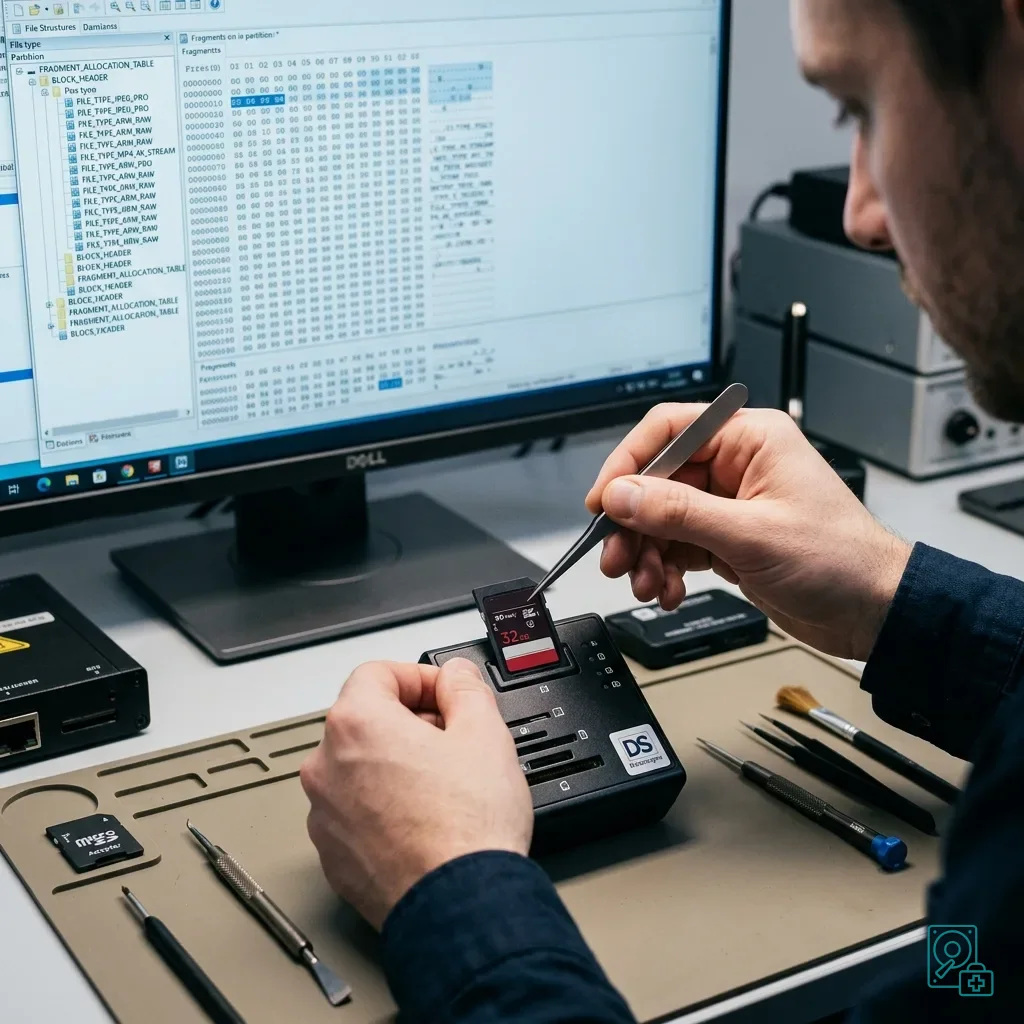
Memory cards hold many kinds of data. JPEG, RAW, long video, drone footage, 4K rushes, audio and specialist equipment files need different validation, and some tolerate missing fragments poorly.
Video is often more demanding than ordinary documents. A large file may lack its index, ending or metadata and require reconstruction or playback in suitable software.
RAW photographs can also be large and structurally specific. A visible thumbnail does not prove that the full image is usable, so validation must go beyond the preview.
Memory cards and 4K cameras explains this for demanding video formats. The more specialized the format, the more carefully the handover must be tested.
Loop-recording devices add another complication because older data may be partly overwritten. Cost then depends on what genuinely remains in memory.
Diagnostic assessment
Prepare Details For An Accurate Quote
A useful quote request needs more than card capacity. Provide the card type, source device, symptom, required files, incident date and actions already attempted.
Keep the card in its current state. Do not reformat, record, repair, glue or force damaged media. Protect a cracked or wet card without aggressive improvised cleaning.
Make priorities concrete: photographs from an event, video from a date, project folder, evidential file, audio recording or camera sequence. This allows the result to be judged by usefulness rather than volume.
A serious assessment should explain possible limits. Some cards permit only partial recovery and overwritten data may be unavailable. Clear scope is more valuable than a promise of total recovery.
Datastrophe assesses the card from its condition, symptoms and expected files. Cost follows that technical analysis, not a simplistic capacity table or promised success rate.
A clear request prevents a vague quote: identify the media, original device, required files and real urgency so the laboratory can explain what will be checked and what depends on memory condition.
Diagnostic assessment
Primary Technical References And Limits
Reference scope — card data recovery cost: For memory card data recovery cost, the primary references used are www.sdcard.org. Physical evidence — card data recovery cost: They define the relevant preservation, storage or validation concepts, but they cannot establish the exact physical condition, controller state, key availability or business consistency of the device received. Controller evidence — card data recovery cost: Those points require measurements on the original set and verification on copies.
Diagnostic assessment
Arrange A Controlled Assessment
Complete set — card data recovery cost: For a technical assessment of memory card data recovery cost, provide the complete device or storage set, its associated power and interface parts, the symptom timeline and the priority files. Incident history — card data recovery cost: Keep member order, labels and authorised credentials separate from the parcel paperwork; do not restart the source merely to obtain a new screenshot.
Laboratory responsibility — card data recovery cost: Datastrophe performs the diagnosis, integrity checks and recovery directly in its own laboratory with its own team. Free assessment — card data recovery cost: Diagnosis and the written estimate are free. Transport boundary — card data recovery cost: Two-way private shipping is included; the carrier moves only the sealed parcel and neither accesses nor processes its data.
Controlled list — card data recovery cost: Before any payment, the client receives the proposed price and a checked list. Verification classes — card data recovery cost: Each item is classified, in order, as recoverable_verified, partial, detected_unverified or unrecoverable. Payment trigger — card data recovery cost: Only recoverable_verified items whose contents were checked and found usable are presented as recoverable. No-result rule — card data recovery cost: Payment is due only after the client accepts both the list and the price.
No-result rule — card data recovery cost: If no usable data is verified, recovery fails, or the client declines the list or price, no standard fee is payable. Rare-part exception — card data recovery cost: The only exception is a rare, costly and non-refundable part, which may be ordered only after a separate, explicit and priced proposal has been accepted.