


Diagnostic evaluation
Plan Quality Checks Before Final Delivery
Final quality checks happen before recovered files are delivered, but their criteria should be set during the initial evaluation. A volume total is not enough; priority files must be present, readable, and consistent with their expected use.
A folder can look complete while containing truncated files. A file may keep its name, date and size while being corrupt, and a database may open partly without supporting real operational recovery. Quality control makes those distinctions visible.
The client supplies the first validation criteria: priority files, formats that must open, important dates and the applications that created the data. Without that context, technically valid but unhelpful items may receive attention.
The data recovery process describes the general stages. This review focuses on the output: preventing a delivery from looking successful when essential files have not been checked.
Quality control should remain measured. It does not promise the impossible or market a partial result as complete; it explains what is usable, missing and still uncertain.

Diagnostic evaluation
Confirm That Visible Files Actually Work
A visible directory entry offers weak proof of usability. The blocks behind it may be missing, overwritten, or fragmented even though the filename still appears in a recovered tree.
Structured formats need special attention. An archive, database, photo catalog, video project or business file may depend on several coherent blocks, and one missing segment can prevent opening or cause later errors.
Quality control therefore tests representative samples. It need not open every file in every case, but should cover critical families such as recent documents, large files, databases, accounts exports, requested photos, video and client folders.
Technical expertise in data recovery explains why method matters more than the tool. Quality control extends that method by turning a technical result into an understandable delivery.
Dates and paths also need review. Recovery may produce several versions of one file, sometimes under temporary paths. Basic sorting prevents noise from hiding the correct folder.

Diagnostic evaluation
Test The Files That Matter Most
Client priorities determine which samples deserve the closest attention. A database, accounting folder, active project, or selected family photos may matter more than thousands of secondary files.
Ask for examples: folder names, extensions, periods, applications, users and projects. They guide both search and checking, and reveal when a large technical result misses the real requirement.
Choose samples carefully. Showing only the easiest files gives a misleading picture. A useful sample covers important formats, priority folders and, where possible, different sizes or dates.
Quality control can also identify duplicates and partial versions. One file may appear under several names, in a temporary directory, local backup or reconstructed area. Explain that situation instead of hiding it.
Incident documentation supports this work. The earlier priorities are recorded, the more precise and useful final checking can be.
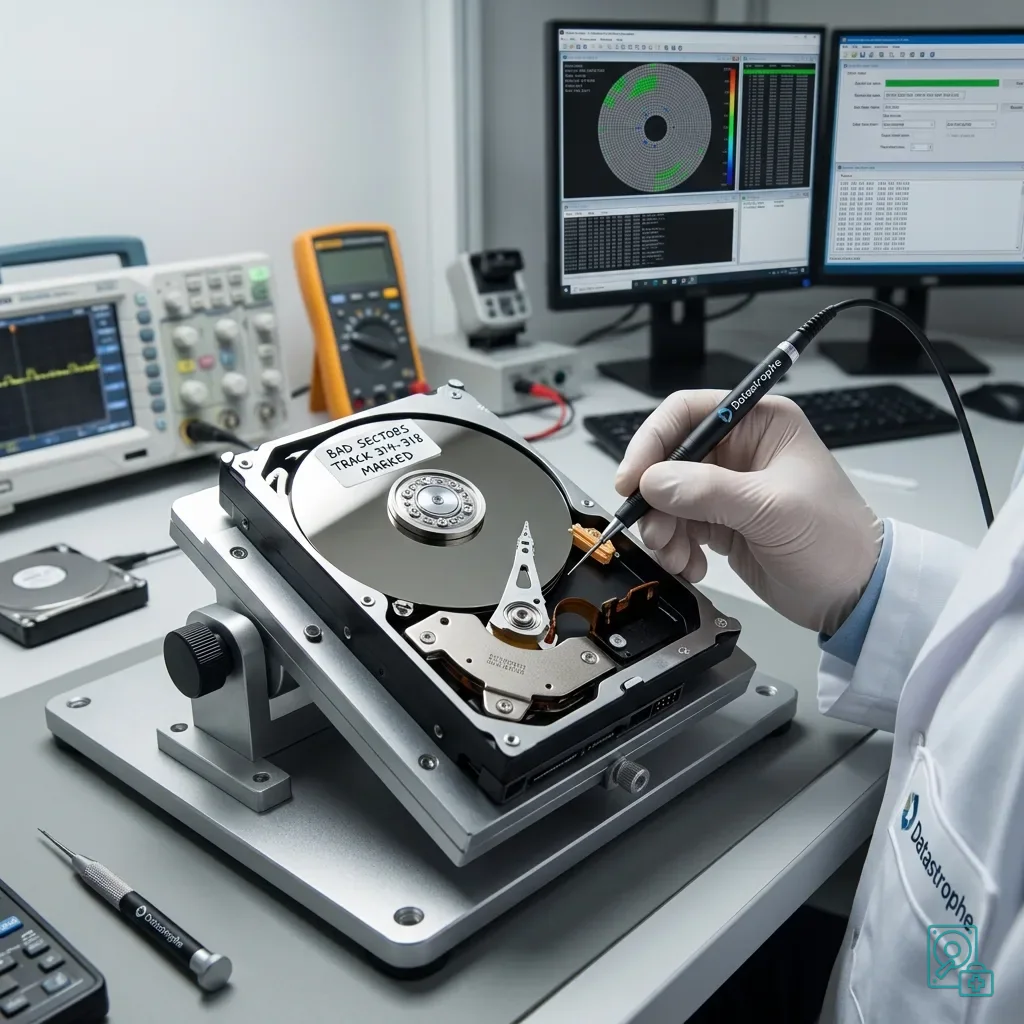
Diagnostic evaluation
State Missing Or Partial Results Clearly
Reliable delivery includes an explicit account of what was not recovered. Recording unreadable sectors, partial files, and inconsistent databases helps the owner plan next steps without overstating the result.
Limits may come from media damage, earlier attempts, logical overwrite, encryption, fragmentation or application corruption. Explaining them shows why the outcome is not merely a question of time or software.
Use accessible language. Partial folder structure, files that will not open, earlier versions and a database requiring its original application are often more useful descriptions than dense technical jargon.
Traceability also helps sensitive cases. When data support an insurance matter, dispute or operational restart, distinguish what was observed, copied, tested and delivered. That rigour protects both client and laboratory.
Data reconstruction and its limits covers partial outcomes in more detail. Quality control makes those boundaries understandable.
Diagnostic evaluation
Use Reliable Media For The Recovered Data
The destination media are part of quality control as well. Recovered data should go onto verified storage that fits the volume and can be checked before the original device is returned.
Do not deliver files back onto the original device. It may remain unstable, damaged or needed for later checks. Use separate media or an agreed delivery method with clear folder organization.
Give the client straightforward information: what was recovered, what was checked, what needs application-level validation and what remains absent or partial. This can be as important as the files.
Client-side validation remains necessary after delivery. A laboratory can check technical readability, but only the client can confirm whether a business project, database or archive serves its real purpose.
Datastrophe uses this quality-control approach to avoid ambiguous handovers. The objective is usable data with a clear confidence level and stated limits, not an impressive headline volume.
Diagnostic evaluation
Primary Technical References And Limits
Reference scope — recovery quality checks before delivery: For data recovery quality checks before delivery, the primary references used are NIST SP 800-86. Physical evidence — recovery quality checks before delivery: They define the relevant preservation, storage or validation concepts, but they cannot establish the exact physical condition, controller state, key availability or business consistency of the device received. Controller evidence — recovery quality checks before delivery: Those points require measurements on the original set and verification on copies.
Diagnostic evaluation
Request A Controlled Evaluation
Complete set — recovery quality checks before delivery: For a technical evaluation of data recovery quality checks before delivery, provide the complete device or storage set, its associated power and interface parts, the symptom timeline and the priority files. Incident history — recovery quality checks before delivery: Keep member order, labels and authorized credentials separate from the parcel paperwork; do not restart the source merely to obtain a new screenshot.
Laboratory responsibility — recovery quality checks before delivery: Datastrophe performs the diagnosis, integrity checks and recovery directly in its own laboratory with its own team. Free assessment — recovery quality checks before delivery: Diagnosis and the quote are free. Transport boundary — recovery quality checks before delivery: Private round-trip shipping is included; the carrier moves only the sealed parcel and neither accesses nor processes its data.
Controlled list — recovery quality checks before delivery: Before any payment, the client receives the proposed price and a checked list. Verification classes — recovery quality checks before delivery: Each item is classified, in order, as recoverable_verified, partial, detected_unverified or unrecoverable. Payment trigger — recovery quality checks before delivery: Only recoverable_verified items whose contents were checked and found usable are presented as recoverable. No-result rule — recovery quality checks before delivery: Payment is due only after the client accepts both the list and the price.
No-result rule — recovery quality checks before delivery: If no usable data is verified, recovery fails, or the client declines the list or price, no standard fee is payable. Rare-part exception — recovery quality checks before delivery: The only exception is a rare, costly and non-refundable part, which may be ordered only after a separate, explicit and priced proposal has been accepted.