
Diagnostic evaluation
Keep Power Away From Wet Hardware
The most damaging reflex after flooding is to power the NAS to check whether it works. Moisture and deposits can create shorts, speed corrosion, or destroy electronics that could otherwise be evaluated.
Even when the surface looks dry, connectors, boards and narrow gaps can retain conductive residue. Air drying does not prove that the equipment is safe to start. For the data, leaving it fully unpowered is more useful than one quick test.
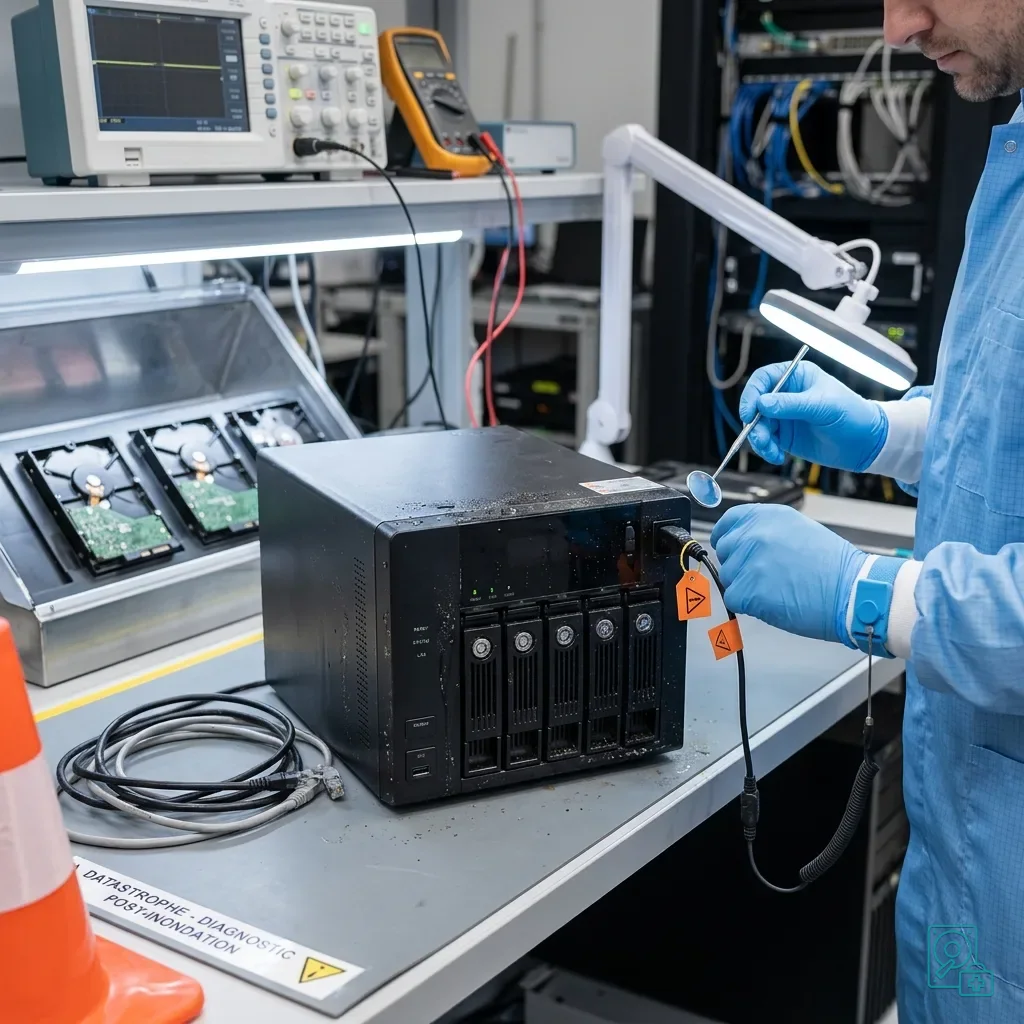
Isolate electricity safely and do not handle live equipment in a wet room. Personal and site safety come first. Once disconnected and accessible, the NAS should be managed as evidence from a physical incident rather than as an ordinary IT fault.
The RAID system data recovery service covers NAS and RAID cases. Flooding adds physical and organizational risks that must be resolved before array or filesystem work begins.
A flooded NAS is not merely a failed enclosure. Water may have affected several disks, the supply, controller, backplane and nearby backup devices at once. The recovery plan must therefore start with the entire incident area and all available data sources.
Avoid forceful drying. High heat, hairdryers, rice, household products and uncontrolled cleaning can move contaminants, leave residue or damage labels needed for identification. The aim is to stabilize the case, not make the enclosure look clean.
Diagnostic evaluation
Account For Uneven Corrosion Across RAID Members
RAID depends on a coherent relationship between its members. Flood exposure can disrupt that relationship through uneven damage, failed power, controller faults, unreadable metadata, or startup attempts that update only part of the set.
Corrosion can progress quickly and beneath visible surfaces. Oxidised connectors and contaminated electronics may cause intermittent errors, so a disk can be recognized once and disappear during sustained reading without being a reliable source.
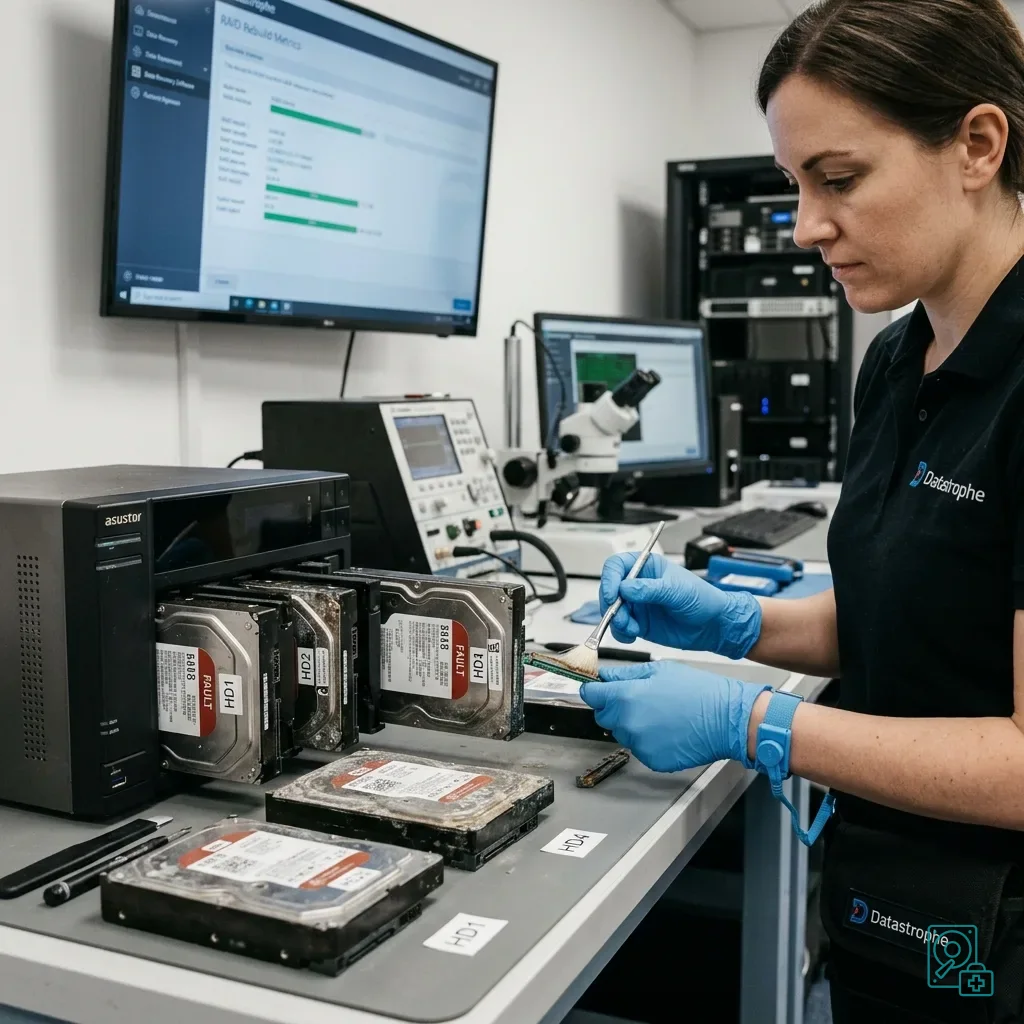
Damage is rarely uniform. A lower bay may have been submerged longer, another disk may have suffered an electrical event, while a third is physically sound but logically dependent on the original RAID layout. Each member needs individual assessment.
Hard-disk flood and water recovery explains one-drive handling. A NAS adds multiple members, shared volumes, array metadata, snapshots and network services that must be reconstructed together.
Prevent automatic reconstruction. If the NAS starts partly, it may offer rebuild, check or initialize actions. These write to members and can reduce recovery options when corrosion or instability affects more than one disk.
Diagnostic evaluation
Photograph Bay Order And Retain The Enclosure
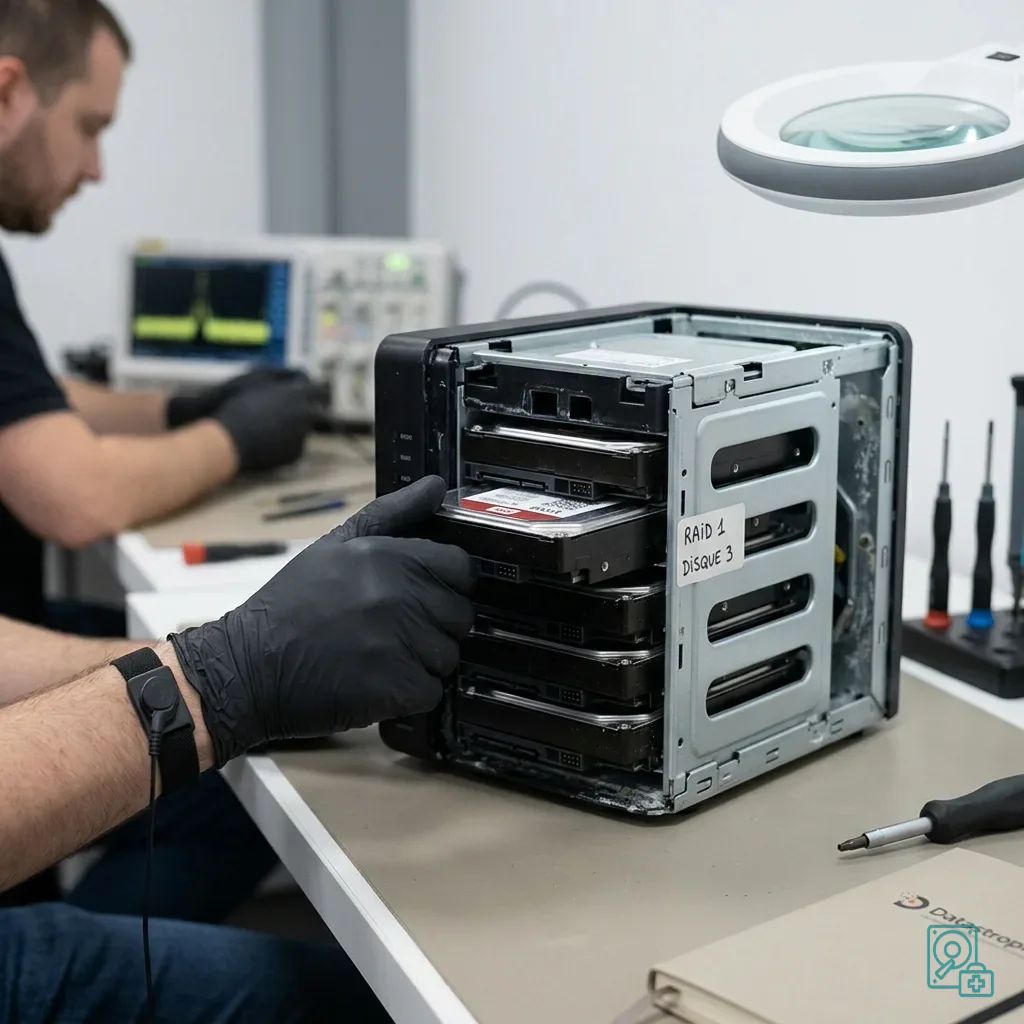
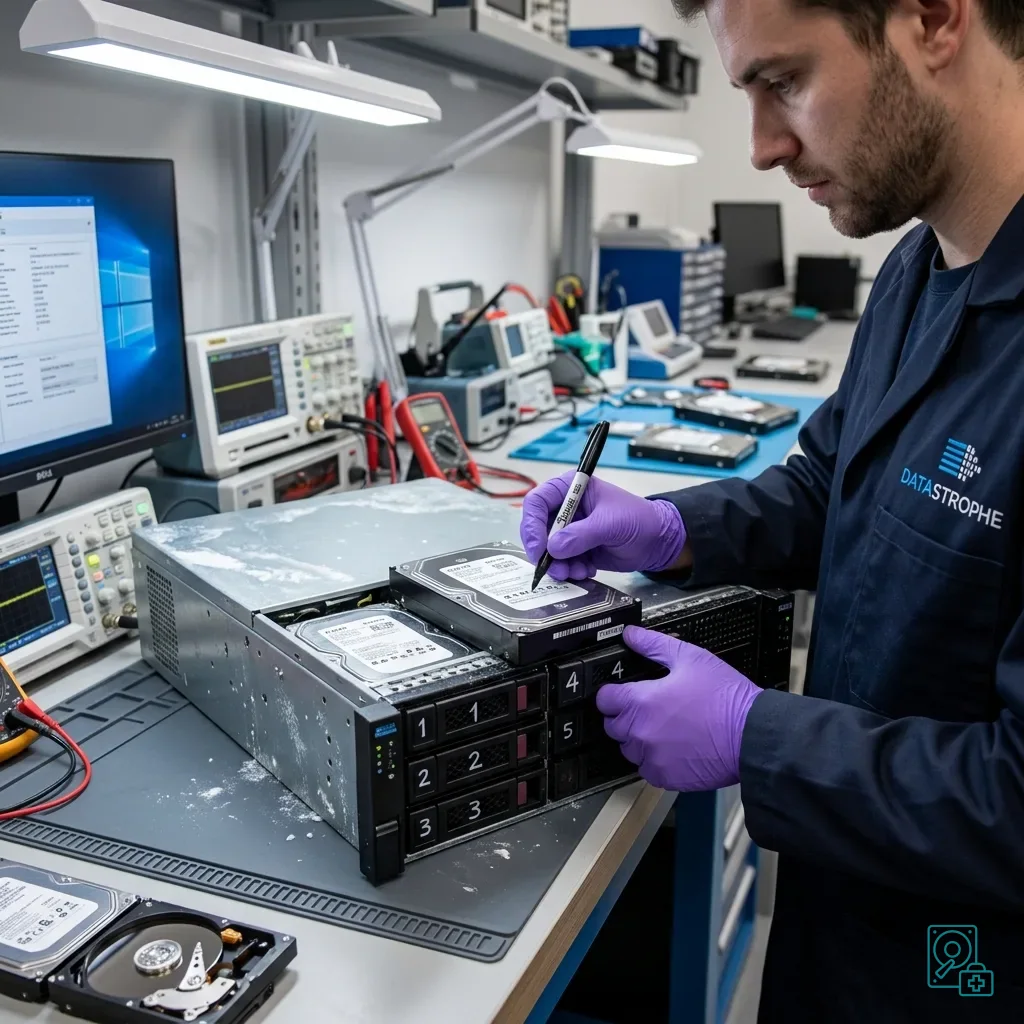
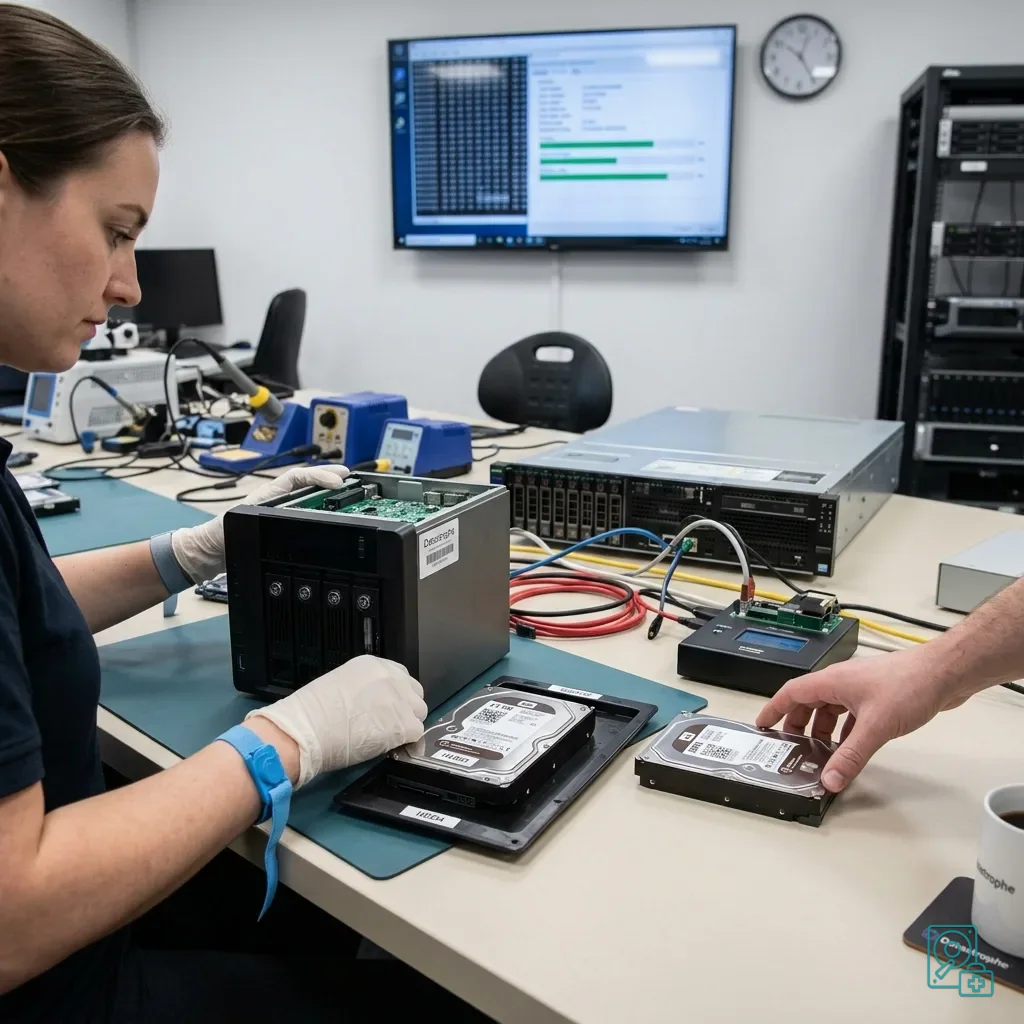
Disk order is essential evidence. Before any removal, photograph each bay and visible model and serial number; one inversion can add needless uncertainty to array reconstruction and metadata comparison.
Retain the enclosure even when it seems unusable. Its model, logs, configuration, controller and volume-management design can help establish how RAID and encryption were organized and which member roles the system expected.
Do not improvise disk cleaning. Safe exterior handling may be necessary, but opening a hard disk, applying strong heat, using products or connecting each member to a computer can introduce mechanical, electrical and logical damage.
Keep useful accessories and records: supply, caddies, labels, screenshots, error notifications and external backup devices. Items that look secondary after a flood may explain disk order, power effects or the last healthy array state.
Incident documentation is particularly valuable here. Flood time, exposure duration, powered state, restart attempts, contamination and exact bay order all influence the handling route.
Diagnostic evaluation
Move Business Continuity To Healthy Storage
Business operations may need to restart quickly, but the flooded appliance should not become the continuity platform. Keep assessment sources separate from healthy replacement storage used for current work.
Evaluate backups on another system. Restoring directly to the incident NAS or reusing its members can overwrite information still needed. A continuity copy should leave every damaged source available for controlled acquisition.
List priority data promptly: customer folders, accounts, databases, production files, legal documents and mail archives. This supports meaningful validation and focuses reading where affected disks may continue to deteriorate.
Business NAS recovery risks covers organizational dependencies. Water adds the possibility that enclosure, members and usual local backup all share one physical failure.
State whether backup storage was also flooded. Recovery strategy changes when an external copy is clean, partial or contaminated, and all sources need separate labels and dates before their content is compared.
Diagnostic evaluation
Return Verified Data And Improve Flood Protection
Return recovered files on healthy media rather than as new writes to the flooded array. Organize the result for use and state limits affecting volumes, directories, permissions, or expected versions.
Validate priority content rather than only reconstructing a visible tree. A partly recovered volume may still contain broken databases or archives, so distinguish files that open and make sense from names that merely appear in a directory.
After the incident, review NAS location, separate backups, electrical protection, flood exposure and shutdown procedure. RAID does not replace a versioned copy outside the area affected by water or fire-suppression systems.
Review access as well. A backup that is untested, inaccessible or stored beside the NAS cannot support reliable continuity. Name who verifies it, how often restoration is tested and how recovery works without the damaged equipment.
Datastrophe can assess flooded NAS members, RAID configuration and related sources. The goal is not to revive the enclosure at any cost, but to preserve data, explain limitations and return verified results on sound storage.
Recovery can proceed in stages, securing critical records before secondary volumes when member stability is limited. This prevents scarce readable sessions from being spent on low-value data while urgent files remain unverified.
Diagnostic evaluation
Primary Technical References And Limits
Reference scope — NAS unpowered topology recovery: For flooded NAS unpowered topology recovery, the primary references used are csrc.nist.gov. Physical evidence — NAS unpowered topology recovery: They define the relevant preservation, storage or validation concepts, but they cannot establish the exact physical condition, controller state, key availability or business consistency of the device received. Controller evidence — NAS unpowered topology recovery: Those points require measurements on the original set and verification on copies.
Diagnostic evaluation
Request A Controlled Evaluation
Complete set — NAS unpowered topology recovery: For a technical evaluation of flooded NAS unpowered topology recovery, provide the complete device or storage set, its associated power and interface parts, the symptom timeline and the priority files. Incident history — NAS unpowered topology recovery: Keep member order, labels and authorized credentials separate from the parcel paperwork; do not restart the source merely to obtain a new screenshot.
Laboratory responsibility — NAS unpowered topology recovery: Datastrophe performs the diagnosis, integrity checks and recovery directly in its own laboratory with its own team. Free assessment — NAS unpowered topology recovery: Diagnosis and the quote are free. Transport boundary — NAS unpowered topology recovery: Private round-trip shipping is included; the carrier moves only the sealed parcel and neither accesses nor processes its data.
Controlled list — NAS unpowered topology recovery: Before any payment, the client receives the proposed price and a checked list. Verification classes — NAS unpowered topology recovery: Each item is classified, in order, as recoverable_verified, partial, detected_unverified or unrecoverable. Payment trigger — NAS unpowered topology recovery: Only recoverable_verified items whose contents were checked and found usable are presented as recoverable. No-result rule — NAS unpowered topology recovery: Payment is due only after the client accepts both the list and the price.
No-result rule — NAS unpowered topology recovery: If no usable data is verified, recovery fails, or the client declines the list or price, no standard fee is payable. Rare-part exception — NAS unpowered topology recovery: The only exception is a rare, costly and non-refundable part, which may be ordered only after a separate, explicit and priced proposal has been accepted.